Why You Play Like a Pro Alone But Fall Apart the Moment Someone's Watching
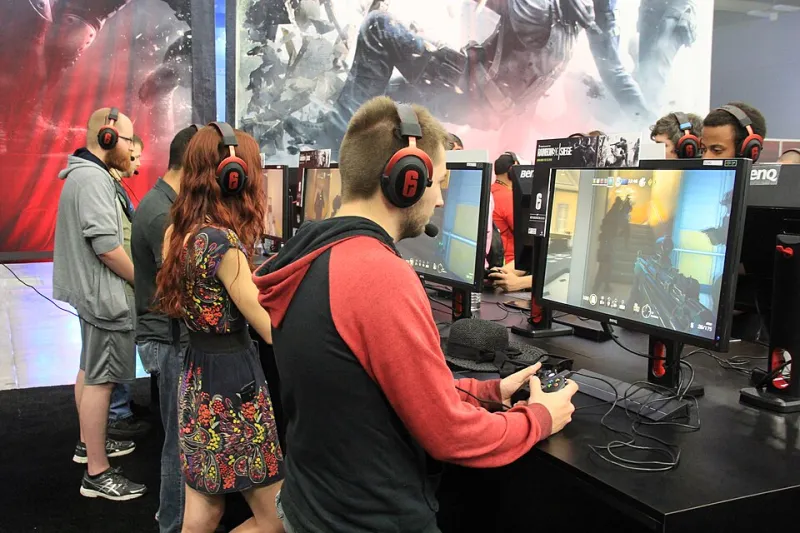
Photo: Daniel Benavides from Austin, TX, CC BY 2.0, via Wikimedia Commons
You've done it a hundred times. You're deep in a solo session, completely locked in, pulling off moves you didn't even know you were capable of. The combo lands perfectly. The puzzle clicks. You clear the level without breaking a sweat. Then your roommate walks in, leans over your shoulder, and suddenly — you can't remember how to jump.
It's one of gaming's most relatable frustrations, and it happens to players across every skill level and genre. Whether you're grinding ranked matches, streaming to a small audience, or just showing a friend your favorite cozy game, the moment eyes land on your screen, something shifts. The magic disappears. The fingers fumble. The brain goes blank.
So what gives? Is it just nerves? Bad luck? Or is something deeper happening under the hood?
Spoiler: it's very much the latter.
The Spotlight Effect Is Messing With Your Head
Psychologists have a name for the way we overestimate how closely other people are watching and judging us — it's called the spotlight effect. We walk around assuming we're under a constant mental microscope, when in reality, most people are way too focused on their own stuff to scrutinize our every move.
In gaming, this phenomenon hits differently. When you're alone, your brain is relaxed, exploratory, and operating mostly on autopilot. You're not second-guessing your decisions because there's no perceived audience to judge them. The second someone enters the room — or worse, you go live — that spotlight feeling kicks in hard. Suddenly every choice feels monumental. Every mistake feels broadcast in HD.
The cruel irony? The more you think about being watched, the worse you tend to play. Your attention splits between executing the game and managing how you appear while executing the game. That mental bandwidth has to come from somewhere, and it usually comes straight out of your performance.
Social Facilitation: It's Not Always Bad News
Here's where it gets interesting. Back in the late 1800s, a psychologist named Norman Triplett noticed that cyclists actually rode faster when racing against others than when riding solo. That observation eventually led to the concept of social facilitation — the idea that the presence of others can improve performance on tasks you've already mastered, but hurt performance on tasks that are new or complex.
For gaming, this plays out in a pretty predictable way. If you've been playing the same game for years and the mechanics are second nature? Having an audience might actually sharpen your focus and push you to perform better. But if you're still learning, or if the game demands creative problem-solving and quick adaptation? Observers become a liability. The extra pressure stifles the flexible thinking you need most.
This is why veteran streamers can play and banter with chat simultaneously, while newer players go completely silent and stiff the moment they hit the "go live" button. It's not confidence — it's repetition. The skill has to be deeply grooved before an audience becomes an asset rather than a distraction.
The Multiplayer Trap Nobody Talks About
Here's a scenario that hits close to home for a lot of casual players: you've been absolutely dominating a game in solo mode. You feel ready to take it online. You queue up, the match starts — and you play like you've never touched a controller in your life.
This isn't just nerves about competition. It's a cocktail of psychological pressures landing all at once. You're now being evaluated by strangers. Mistakes have social consequences (judgment, maybe some trash talk). The stakes feel higher, even if the only thing on the line is a digital ranking.
Your brain, bless it, responds to all of this by going into a mild threat-response mode. Heart rate ticks up. Attention narrows. The creative, intuitive part of your gameplay gets shoved aside in favor of cautious, overthought decision-making. You stop playing and start performing — and those two things are not the same.
Practical Ways to Close the Gap
The good news is that this isn't a permanent condition. There are real, practical ways to shrink the distance between your private-session brilliance and your observed-play anxiety.
Start with low-stakes exposure. Don't jump straight into streaming or competitive matches to "face your fears." Instead, invite one trusted friend to watch a casual session first. Get comfortable with a single set of eyes before scaling up. The goal is to normalize the feeling of being watched in a context where nothing is on the line.
Practice under mild pressure. Set a timer while you play solo. Record yourself even if you never share the footage. These small self-imposed pressures mimic the feeling of being observed without the actual social stakes, and over time they help your brain associate performance with a calmer baseline state.
Shift your focus inward. When you feel the spotlight effect creeping in, redirect attention to physical sensations — the controller in your hands, your breathing, the specific action you're about to take. This is a technique borrowed from sports psychology called process focus, and it's incredibly effective at pulling your brain back from self-monitoring spiral.
Embrace the fumble. Seriously. One of the fastest ways to defuse performance anxiety is to remove the catastrophizing around mistakes. If you mess up in front of people, laugh it off out loud. Narrate it. "Yep, that was terrible." Owning the error out loud short-circuits the shame loop that usually follows, and it keeps you present instead of mentally replaying the fumble while the game keeps moving.
Log your solo wins. Keep a casual mental (or literal) note of the moments when you played really well alone. Over time, this builds a reference library your brain can pull from when anxiety tries to convince you that you're not actually that good. You have the receipts.
The Bigger Picture
At the end of the day, gaming is supposed to be fun — and fun is genuinely harder to access when you're tangled up in self-consciousness. The solo-to-observed performance gap isn't a flaw in your gaming ability; it's a totally human response to social pressure that shows up in athletes, musicians, public speakers, and yes, gamers.
What makes gaming a uniquely great space to work through this stuff is that the stakes are low and the feedback is immediate. Every session is a chance to practice not just the game, but the mental game around the game. And that's a skill with way more range than any single title.
So next time you catch yourself playing flawlessly the moment your friend leaves the room, don't be too hard on yourself. Your brain is just doing what brains do. The trick is learning how to bring a little of that alone-room energy with you — wherever you play.

